The Housing Crisis in McHenry County: What the Data Says — and What We Can Do About It
Published by Neighbors for a Better McHenry County PAC
McHenry County has a housing problem. Not the kind that makes headlines the way Chicago’s housing challenges do, and not the kind that gets talked about at kitchen tables — at least not yet. But the data is clear, the trend is unmistakable, and the consequences for working families are already being felt.
This past May, the Chicago Metropolitan Agency for Planning — CMAP, the comprehensive planning organization for northeastern Illinois — released its McHenry County Housing Readiness report, the product of a multi-year partnership with the county, local municipalities, real estate professionals, and developers. The findings are worth understanding by every McHenry County resident who cares about the future of this community.
Here’s what they found.
The Numbers Don’t Lie
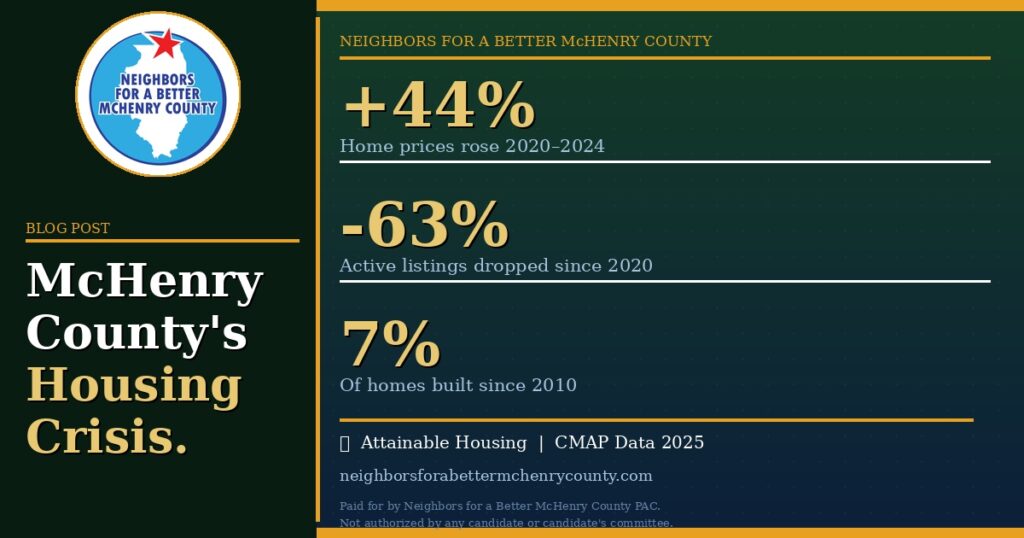
Home prices have surged. The median home sales price in McHenry County grew 44% from 2020 to 2024, climbing from around $240,000 to over $335,000. That’s not a blip — that’s a structural shift in what it costs to buy a home here.
There aren’t enough homes. Active residential listings in McHenry County dropped 63% between 2020 and 2025 — from 1,560 available homes to just 458. Supply has collapsed while demand has stayed strong. When there aren’t enough homes to go around, prices rise and families get squeezed out.
The housing stock is old. Only 7% of homes in McHenry County have been built since 2010. More than 70% of homes were built before 2000, and half were built before 1989. An aging housing stock means higher maintenance costs, less energy efficiency, and homes that don’t match the needs of modern households.
Working families can’t afford it. The CMAP analysis found that households earning less than $75,000 a year are almost universally cost-burdened by housing — meaning they spend more than 30% of their income on housing costs. For renters earning under $35,000, that figure tops 88%. And the most common jobs in the county — laborers, retail salespersons, cashiers, fast food workers — pay wages that don’t support even a one-bedroom apartment.
Half the county’s workers commute in from somewhere else. About 70% of McHenry County residents work outside the county. And roughly half of the people who work in McHenry County commute in from other places because they can’t afford to live here. Over 75% of workers drive alone, logging about 30% more vehicle miles than the average household in the region. The housing shortage isn’t just a housing problem — it’s a transportation and quality-of-life problem.
This Isn’t Just About “Affordable Housing”
One of the important reframes in the CMAP report is the concept of “attainable housing” — homes that working households at 80 to 120 percent of area median income can actually afford. This isn’t about subsidized housing. It’s about whether a teacher, a nurse, a tradesperson, a retail manager, or a first-year police officer can afford to live in the community where they work.
The answer in McHenry County, increasingly, is no.
Consider the county’s five most common jobs. Laborers and material movers earn a mean annual wage of around $43,200 — enough to afford a studio apartment, but not a one-bedroom. Retail salespersons average $38,840 — same situation. Cashiers average $33,970. Fast food workers average $33,390. Neither group can afford even a studio. And here’s the kicker: less than 1% of all homes in McHenry County are studios.
The gap between what jobs pay and what housing costs is not a gap that working families can budget their way out of. It requires policy action.
What CMAP Says the County Needs to Do
The Housing Readiness report isn’t just a diagnosis — it’s a prescription. CMAP identified six core strategies for McHenry County and its municipalities to pursue.
Communicate and engage with residents. Housing conversations are often derailed by fear and misinformation. Communities that make housing decisions based on good information — and that actively involve residents in those conversations — make better decisions.
Review zoning regulations and design standards. Much of McHenry County’s zoning was written decades ago for a very different housing market. Outdated rules that prohibit duplexes, triplexes, accessory dwelling units, and smaller starter homes artificially constrain supply. Developers who engaged with CMAP’s process were explicit: updating zoning and design standards is essential to producing more attainable units.
Streamline development rules and processes. Navigating development approvals across multiple municipalities is costly and time-consuming. Every dollar and month added to the development process is a cost that ultimately gets passed on to the buyer or renter. Simplifying and standardizing processes makes it easier and cheaper to build.
Pursue housing funding and financing tools. State and federal programs exist to help communities expand housing supply — but accessing them requires capacity, coordination, and leadership. McHenry County has an opportunity to build stronger connections with the Illinois Housing Development Authority and to help municipalities leverage funding they’re currently leaving on the table.
Coordinate land use, transportation, and economic development. About 4% of McHenry County’s land is vacant — and much of it is near jobs and transit. Building on infill sites rather than sprawling into farmland is both fiscally smarter and environmentally sounder. The county needs leadership that connects these dots.
Foster public-private and multi-jurisdictional partnerships. Housing is a regional challenge that no single municipality can solve alone. McHenry County needs coordinated action across municipal lines — and an active county government willing to lead that coordination rather than leaving it to chance.
What the County Board Has to Do With This
Here’s the part that connects directly to the 2026 elections.
CMAP’s report identifies specific actions the county itself — not individual municipalities — can and should lead. These include developing a countywide inventory of opportunity sites for housing development, creating guides for accessory dwelling unit development, building municipal capacity to leverage housing funding, and establishing a public-private regional housing trust fund.
These are County Board decisions. They require county leadership. And right now, the County Board has not taken them seriously.
The same board that has relied on tax freezes to avoid hard conversations about county finances has also avoided hard conversations about housing. The result is a county that has a CMAP action plan sitting on the shelf, a housing crisis getting worse by the year, and working families being quietly pushed out of a community they helped build.
What Attainable Housing Actually Looks Like
It’s worth being concrete about what we’re talking about, because “housing policy” can sound abstract until you see it in human terms.
Think about a teacher and a school administrator — two professional, dual-income household members — living with their three children and the administrator’s aging parents. They want to give everyone a dignified living space. Their options, per the CMAP analysis: refinish the basement for $22,000, build a home addition for $46,000, or build a backyard coach house for $175,000. The cheapest option still takes more than a year to save for. And in some McHenry County communities, the coach house isn’t even permitted under local zoning.
That’s the housing reality facing working families here — not in some abstract policy document, but in actual homes, with actual families, making impossible choices.
Attainable housing means giving that family options. It means zoning rules that allow a duplex, a granny flat, a smaller starter home. It means development processes that don’t add unnecessary cost and delay. It means county leadership that takes the problem seriously instead of pretending it doesn’t exist.
The Bottom Line
McHenry County has abundant farmland, open space, a strong community character, and a workforce that earns enough to drive real demand for housing. These are assets. But they will not protect the county from a worsening housing crisis if local elected officials continue to ignore the evidence and avoid the policy changes needed to address it.
The good news is that the roadmap already exists. CMAP produced it in partnership with the county itself. The question is whether the County Board will follow it — or whether it will take new leadership in 2026 to finally get moving.
Neighbors for a Better McHenry County PAC is working to elect board members who will take housing attainability seriously. Not because it’s a partisan issue, but because it’s a community issue — one that affects our teachers, our nurses, our tradespeople, our seniors, and our young families.
McHenry County is worth fighting for. That means making sure the people who make it run can afford to live here.
Sources: CMAP McHenry County Housing Readiness Market Analysis and Action Plan, May 2025; Heartland Realtors, 2025; U.S. Bureau of Labor Statistics, 2024; McHenry County Analysis of Impediments to Fair Housing, 2025.
Neighbors for a Better McHenry County PAC is working to elect responsible, accountable leaders to the McHenry County Board. Learn more at neighborsforabettermchenrycounty.com.
Paid for by Neighbors for a Better McHenry County PAC. Not authorized by any candidate or candidate’s committee.